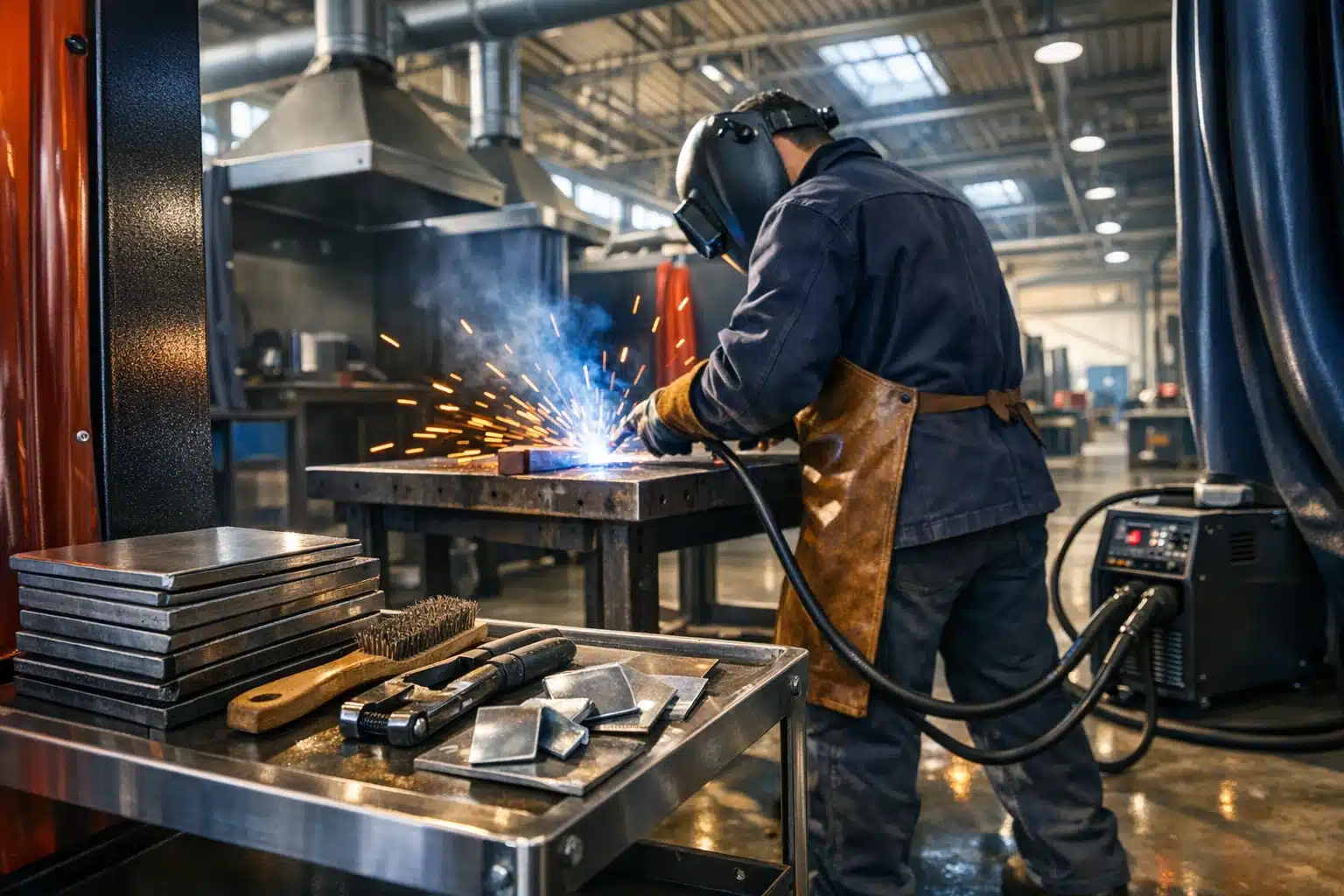
 Artificially generated image
 Welding Training: Skills, Courses, and Career Paths
Welding training is where raw interest turns into disciplined skill, because strong welds support everything from farm gates to offshore platforms. Whether you want a fast path into the trades or a long-term technical career, learning to weld opens doors in manufacturing, construction, energy, and repair. But training is more than striking an arc; it teaches safety, blueprint reading, metal behavior, and the patience to make clean, reliable joints. This guide maps the main routes, core skills, certifications, and career options so you can decide where to start and how far to take it.
Article outline:
- What welding training includes and why it matters
- How trade schools, colleges, apprenticeships, and employer programs compare
- The practical and technical skills students build in the shop
- Certifications, tools, and areas of specialization
- Career paths, earnings, and how to choose the right program
What Welding Training Really Covers
People sometimes imagine welding instruction as a narrow craft built around one simple task: joining metal with heat. In reality, a solid program is much broader. It introduces students to safety procedures, equipment setup, joint preparation, metal identification, drawing interpretation, quality control, and multiple welding processes. The first days in a shop often begin with the basics, such as personal protective equipment, fire prevention, electrical awareness, and how to move safely around hot material. That foundation matters because welding can be rewarding, but it is not casual work. A training booth may glow like a tiny sunrise when the arc starts, yet every spark demands control, attention, and respect.
Most entry-level programs expose students to several common methods. These usually include Shielded Metal Arc Welding, often called stick; Gas Metal Arc Welding, commonly known as MIG; Flux-Cored Arc Welding; and Gas Tungsten Arc Welding, widely called TIG. Each process has different strengths. Stick welding is valued for outdoor work and rougher conditions. MIG is often easier for beginners to grasp and is widely used in fabrication. TIG is slower and more precise, making it popular for thinner metals, stainless steel, and aluminum. Students also learn that metal thickness, position, cleanliness, and project requirements all influence which method makes sense.
A quality course also teaches shop habits that employers notice quickly. These include:
- Measuring accurately before cutting or fitting
- Cleaning material so the weld is not contaminated
- Checking machine settings instead of guessing
- Inspecting finished welds for defects such as porosity, undercut, or lack of fusion
- Maintaining a work pace that balances speed with consistency
Another important point is that training is not only for future pipeline or structural welders. It can fit many kinds of learners. Recent high school graduates may see it as a direct route into a trade. Career changers often like the clear link between skill and employability. Hobbyists sometimes start with evening classes, then decide they want more serious credentials. The difference between a casual introduction and a career-focused program usually comes down to depth. A short community workshop may teach safe use of a welder and basic bead placement, while a professional course prepares students to pass tests, read welding symbols, and work to code. That wider preparation is what turns practice into a profession.
Comparing Training Routes: Trade Schools, Community Colleges, Apprenticeships, and Employer Learning
There is no single route into welding, which is good news for students with different budgets, schedules, and goals. The most common starting points are trade schools, community colleges, apprenticeships, and employer-based training. Each option can lead to useful skills, but they differ in speed, cost, academic depth, and how quickly students enter paid work.
Trade schools are often the fastest formal path. Many certificate programs can be completed in roughly 6 to 12 months, though some run longer. Their strength is focus. Students spend a large share of their time in the shop, learning process fundamentals, joint design, position welding, and basic fabrication. This route appeals to people who want concentrated practical instruction without a long general-education schedule. The tradeoff is that some shorter programs provide less background in math, metallurgy, communication, or drafting than a broader college curriculum.
Community colleges usually offer certificate tracks and associate degrees. An associate degree often takes about two years and can include coursework in blueprint reading, metallurgy, inspection, and industrial safety alongside hands-on booth time. This path may suit students who want a more rounded technical education or who may later move into supervision, quality control, or related industrial roles. In many regions, community colleges can also be a cost-effective choice, especially for local residents.
Apprenticeships follow a different model. Instead of learning first and working later, apprentices earn while they train. These programs, often linked to unions or employers, may last three to five years and combine classroom instruction with real jobsite experience. That means students see how welding fits into larger systems such as structural steel erection, pipe installation, shutdown maintenance, or ship repair. Apprenticeships can be highly valuable, but entry may be competitive and the pace is demanding.
Some learners enter through employer training, especially in manufacturing plants or fabrication shops. This can work well when a company has structured mentorship, but the quality varies. If the shop only teaches one repetitive task, the worker may gain speed without building a broad foundation.
When comparing programs, it helps to ask practical questions:
- How many hours are spent welding, not just watching demonstrations?
- Which processes and materials are covered?
- Are certification tests included or available on site?
- What is the student-to-instructor ratio in the shop?
- Does the school track job placement or employer partnerships?
The right route depends on your timeline and aims. If you want quick entry, a focused certificate may be enough. If you want wages while you learn, an apprenticeship may fit better. If you want technical breadth and flexibility, a college program can make sense. Choosing well is less about prestige and more about matching the training model to the career you actually want.
Core Skills Students Build in the Booth and Beyond
Learning to weld well involves far more than making metal stick together. Good instruction develops a combination of hand control, technical understanding, visual judgment, and disciplined work habits. One of the first challenges for beginners is puddle control, which means watching the molten metal and guiding it with the correct speed, angle, and heat input. This is where welding begins to feel less like using a tool and more like learning a physical language. The torch, electrode, or gun responds to tiny movements, and the bead records every hesitation.
Programs typically begin with flat-position practice because it is easier to manage. From there, students move to horizontal, vertical, and overhead work. Each position changes how gravity affects the puddle, so technique must adjust. Joint preparation is another major skill. A welder needs to understand fit-up, bevel angles, root openings, tack placement, and material cleanliness. A beautiful bead can still fail if the joint was prepared poorly, which is why training emphasizes the entire workflow instead of only the visible finish.
Technical reading skills matter just as much. Students learn welding symbols, dimensions, tolerances, and blueprint conventions. In many workplaces, a welder is expected to build or repair parts according to drawings, not improvisation. A mistake of a few millimeters can cause alignment problems, weak connections, or expensive rework. Basic math also appears often, especially in measurement, layout, fractions, angles, and material estimation.
Metallurgy enters the picture as students advance. Different metals respond differently to heat, filler material, and cooling rate. Mild steel is usually forgiving for beginners, while aluminum and stainless steel require more control and attention. Instruction may cover distortion, heat-affected zones, preheating, interpass temperature, and why some materials crack if procedures are ignored. These lessons help explain not just what works, but why it works.
Safety stays woven through every stage of training. Students learn to prevent burns, eye injury, fumes exposure, and fire risk. Strong programs also teach professional shop behavior, such as housekeeping, tool care, and communication around lifts, grinders, gas cylinders, and energized equipment.
Common early skill areas include:
- Arc length and travel speed control
- Electrode or torch angle
- Reading weld profiles and spotting defects
- Grinding, cutting, and edge preparation
- Sequencing welds to reduce warping
Over time, competence grows through repetition with feedback. That is why the best courses provide many hours under the hood, instructor critique, and chances to test work against clear quality standards. Muscle memory matters, but informed muscle memory matters more.
Certifications, Equipment, and Areas of Specialization
Once students have basic technique, the next big question is often certification. In welding, certification usually refers to proving skill through a practical test rather than simply attending classes. Employers and industries want evidence that a welder can produce sound welds under specific conditions. A person may complete a program and still need to pass a performance test for a company, code, or jobsite requirement. That is why students should see training and certification as connected, but not identical.
In the United States, the American Welding Society is one of the best-known organizations in this space, and many schools prepare students for tests built around recognized standards. Depending on the job, welders may also work under codes tied to structural steel, pressure vessels, piping, shipbuilding, or aerospace applications. The details vary, but the principle stays the same: the more demanding the work, the stricter the procedure and inspection requirements tend to be.
Specialization matters because welding is not one labor market. A structural welder on large building components, a pipe welder in an industrial plant, and a TIG welder fabricating stainless equipment may all use different procedures, materials, and acceptance criteria. Some fields reward precision and cleanliness above all else. Others prize endurance, field adaptability, and the ability to work in awkward positions or changing weather.
Common specialization paths include:
- Structural steel welding for construction and infrastructure
- Pipe welding for power plants, refineries, and process systems
- Fabrication for manufacturing, trailers, machinery, and custom metalwork
- Sheet metal and thin-gauge work, often using TIG or MIG
- Stainless steel or aluminum welding for food equipment, marine work, or transport
- Robotic welding and automated production support
Equipment knowledge also grows during training. Students learn the difference between constant-voltage and constant-current machines, shielding gases, wire feed settings, tungsten types, electrodes, clamps, and consumables. They also discover that small setup choices can change weld quality dramatically. A dirty ground connection, incorrect gas flow, or poorly chosen filler metal can undo careful technique. Understanding the machine is part of understanding the craft.
As careers progress, some welders branch into fitting, inspection, supervision, programming of robotic cells, or welding engineering support roles. Others pursue advanced credentials related to inspection or quality assurance after gaining field experience. In that sense, certification is not just a badge. It is a way of marking capability, building trust with employers, and opening doors to more specialized work where accuracy carries serious consequences.
Career Paths, Earnings, and Choosing the Right Program for Your Future
For many readers, the practical question is simple: where can welding take me? The answer depends on skill level, industry, location, and willingness to keep learning. Trained welders work in manufacturing plants, repair shops, construction firms, shipyards, energy facilities, rail operations, farms, heavy equipment companies, and custom fabrication businesses. Some stay in one indoor shop for years. Others travel from project to project, following shutdowns, industrial maintenance contracts, or infrastructure work. The variety is one of the field’s strongest advantages.
Earnings also vary widely. Entry-level roles may start modestly, especially if a worker is only using basic MIG skills in repetitive production. However, wages often rise with certification, process range, reliability, and the ability to handle harder positions or code work. In recent labor data, welders in the United States have typically earned median annual pay in the upper forty-thousand-dollar range, while specialists in pipe, shutdown, travel-heavy, or high-risk environments can earn much more through overtime and premium assignments. Income is real, but it is tied to competence, consistency, and working conditions, not magic promises.
That said, welding is not an effortless career. It can be physically demanding, hot, noisy, and exacting. Some jobs require long hours, awkward body positions, respirator use, or outdoor work in difficult weather. A good program should prepare students for that reality instead of selling a fantasy. The strongest graduates usually understand three things early: safety is non-negotiable, precision matters every day, and learning does not stop after school.
If you are choosing a program, match it to your actual goal. Someone aiming for quick local employment in a fabrication shop may not need the same training path as a person who wants pipe work on industrial sites. Visit the facility if possible. Look at the booths, the machines, the ventilation, and the projects students complete. Ask whether instructors have recent industry experience and whether employers recruit from the program.
A useful checklist includes:
- Your budget and how fast you need to start earning
- The industries hiring in your region
- Whether you prefer classroom structure or jobsite learning
- The number of shop hours included
- Access to certification testing and placement support
For beginners, career changers, and hands-on learners, welding can offer a grounded path with visible progress. You build a skill that leaves evidence in steel, stainless, or aluminum every single day. If that kind of work appeals to you, the smartest next step is not guessing from the sidelines. It is choosing credible training, practicing with patience, and building a skill set that can carry you from a first bead to a long, durable career.