Warehouse Services: Storage and Inventory Solutions for Businesses
Introduction and Article Outline
Warehouses rarely attract attention until stock runs late, shelves empty out, or shipping costs start climbing. That quiet space at the edge of town is often where margin, customer trust, and operational rhythm are either protected or lost. For manufacturers, retailers, wholesalers, and online sellers alike, the right mix of storage design, handling processes, and inventory control turns square footage into a working asset. This article maps the core service models, compares storage options, and shows how businesses can build inventory systems that stay practical as demand shifts.
At a glance, warehouse services may seem like a simple promise: receive goods, store them, and ship them out when needed. In reality, the warehouse sits at the center of a much larger operational story. It influences how quickly a business can replenish stores, how safely products are handled, how much cash is tied up in stock, and how reliably customer orders reach the right destination. A well-run site reduces avoidable touches, shortens travel time, improves visibility, and makes labor more productive. A poorly designed one does the opposite, often quietly at first and then all at once.
This article is organized in five parts so readers can move from the broad picture to practical decisions. Outline: • Part 1 explains why warehouse strategy matters and how the rest of the discussion is structured. • Part 2 breaks down warehouse services such as receiving, put-away, storage, picking, packing, value-added work, and reverse logistics. • Part 3 compares warehouse storage solutions, from selective racking to automation, based on space use, accessibility, and product profile. • Part 4 examines inventory storage solutions including slotting, replenishment, forecasting, cycle counting, and warehouse management systems. • Part 5 helps businesses evaluate providers, costs, and performance indicators while closing with a practical summary.
The relevance of this topic has grown with the rise of e-commerce, tighter delivery expectations, and greater supply chain uncertainty. Customers now expect accuracy and speed as standard service levels, not premium extras. At the same time, many businesses carry wider product ranges than they did a decade ago, which increases complexity inside the building. More stock-keeping units, more order profiles, and more shipping channels place pressure on layout, software, staffing, and replenishment rules. The warehouse is no longer a back-room necessity; it is a competitive tool. When companies choose the right warehouse services and match them with sensible storage and inventory practices, they gain control over service quality, working capital, and room to grow.
Warehouse Services: What They Include and Why They Matter
Warehouse services cover much more than storing pallets between inbound and outbound transport. In a modern operation, services often begin before goods even enter the building. Advance shipment notices, dock scheduling, and receiving plans help teams prepare labor and space. Once products arrive, warehouse staff check quantities, inspect packaging, confirm lot or serial data where needed, and move stock into assigned locations. That receiving-to-put-away process sounds routine, but it sets the tone for everything that follows. A receiving error can ripple through order fulfillment, stock counts, replenishment, and customer service for days.
Core warehouse services usually include several linked functions. Common examples are: • inbound receiving and inspection • put-away and location assignment • pallet, case, or each-pick storage • order picking and packing • labeling, kitting, or light assembly • returns processing • cross-docking for goods that move quickly without long-term storage. Businesses may buy these services from a public warehouse, contract with a third-party logistics provider, or operate them in a private facility. Each model has advantages. Private warehousing offers direct control and may suit stable, high-volume operations. Public warehousing can be flexible for seasonal demand. Third-party logistics providers often add transportation management, systems integration, and multi-client efficiency.
Service quality matters because warehouse performance directly affects measurable outcomes. Order accuracy targets in professionally managed facilities often aim for 99 percent or higher, since even small error rates create expensive customer service issues. Labor is typically the largest warehouse operating cost and, in many operations, accounts for more than half of total expense. That means service design is not only about customer satisfaction; it is also about cost control. Efficient batching, zone picking, and wave planning can reduce travel time. Standardized packing stations lower rework. Slotting fast movers near dispatch shortens picker routes. Each improvement may look modest on paper, yet together they can materially change cost per order.
There is also a human side to warehouse services. A well-run operation feels less like chaos and more like a well-rehearsed stage production where every movement has a cue. Drivers know their appointment windows. Receivers have clear check procedures. Pickers follow optimized routes. Supervisors can see backlog before it becomes a crisis. In contrast, poor service design shows up as congestion at the dock, stock in temporary locations, delayed replenishment, and people spending time searching instead of handling. Businesses evaluating warehouse services should look beyond storage rates alone and ask sharper questions: What is the cut-off time for same-day shipping? How are returns processed? What is the average dock-to-stock time? How are damaged goods recorded? Those answers reveal whether a warehouse is simply a building with shelves or a genuine operating partner.
Warehouse Storage Solutions: Matching Space, Product Type, and Throughput
Warehouse storage solutions are not one-size-fits-all, because products behave differently in storage. A pallet of canned goods, a rack of apparel, a roll of carpet, and a tray of temperature-sensitive cosmetics each demand distinct handling conditions. The right storage design balances three practical goals: density, accessibility, and speed. The challenge is that improving one can sometimes reduce another. High-density systems save space, but they may limit access to every SKU. Highly accessible systems support fast picking, but they can consume more floor area. Good design starts with SKU dimensions, order frequency, replenishment cycles, weight, fragility, and shelf-life requirements.
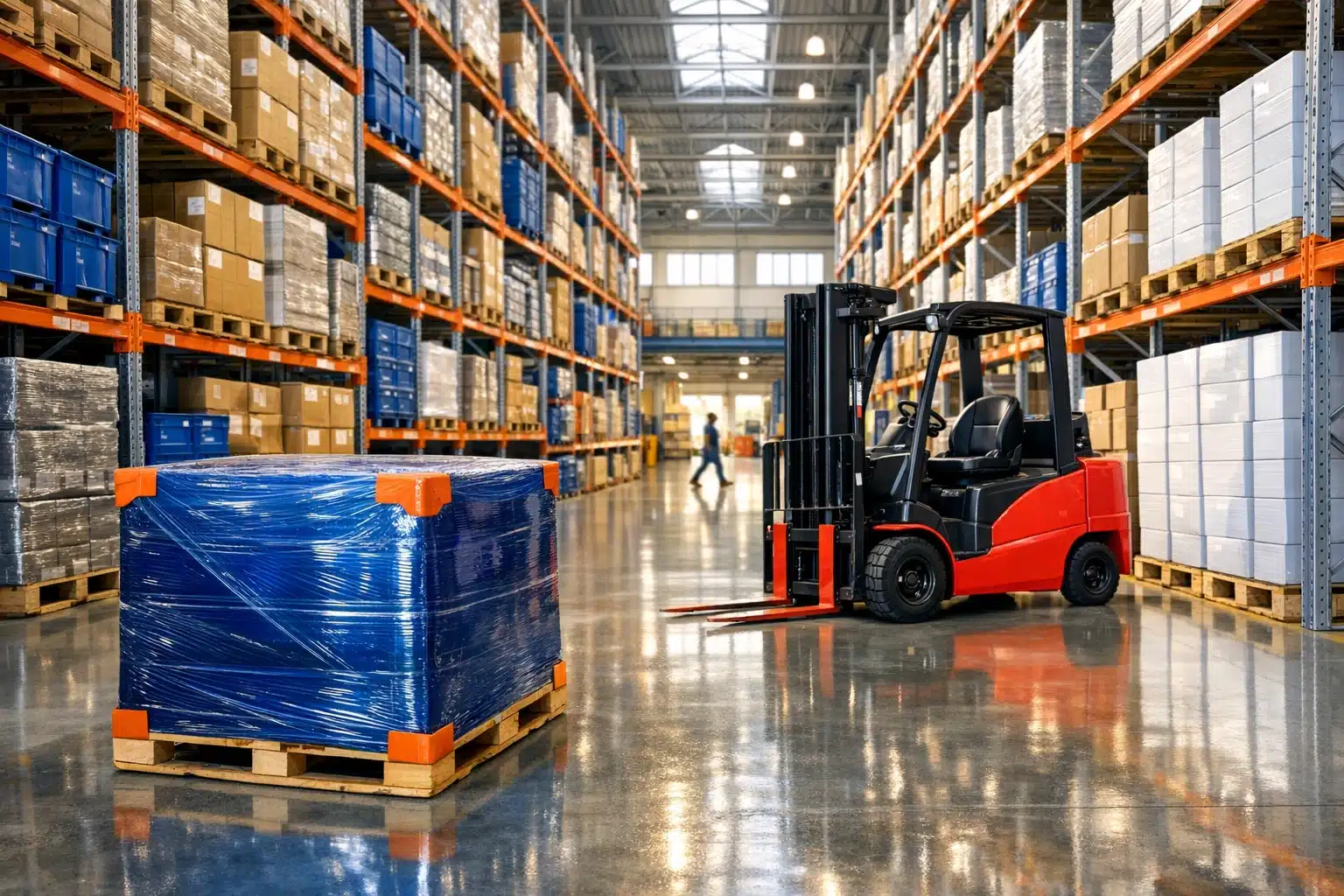
Several storage solutions appear frequently in business warehouses. Selective pallet racking is common because it gives direct access to every pallet and suits mixed inventory. Drive-in or drive-through racking improves density for larger volumes of the same SKU but reduces selectivity. Double-deep racking sits in the middle, trading some accessibility for better use of cubic space. Shelving systems suit smaller items and hand-pick operations. Cantilever racking works well for long, bulky goods such as timber, pipes, or metal sections. Mezzanines add usable levels without expanding the building footprint. For operations with high throughput and predictable SKU behavior, automated storage and retrieval systems can improve speed and space use, although they require more capital and careful maintenance planning.
Temperature-controlled storage deserves separate attention. Food, pharmaceuticals, chemicals, and certain beauty products may require cold, chilled, or tightly monitored environments. In these settings, storage design is shaped not only by efficiency but also by compliance and product integrity. Energy use, air flow, insulation quality, and door discipline all affect cost. For example, a poor layout that causes excessive door openings can increase energy consumption and make temperature stability harder to maintain. Hazardous materials bring further requirements around segregation, ventilation, fire suppression, and labeling. The storage solution must therefore align with regulatory standards as well as operational needs.
Space optimization has become a major theme in warehouse planning because real estate and labor costs continue to pressure margins. Companies often recover capacity without moving buildings by improving slotting, reducing obsolete stock, using narrower aisles with suitable equipment, or introducing vertical solutions. Depending on the starting point and SKU profile, businesses can sometimes unlock meaningful gains in usable capacity through redesign rather than expansion. Still, the smartest storage solution is not necessarily the most advanced one. A straightforward selective racking layout supported by disciplined replenishment may outperform a more complex system that the team cannot operate consistently. The real test is fit. If the solution supports product safety, quick access where needed, sensible travel paths, and scalable growth, it is doing its job well.
Inventory Storage Solutions: Control, Visibility, and Smarter Stock Decisions
Inventory storage solutions focus on a different but closely related question: not just where stock sits, but how it is controlled, counted, replenished, and made visible. A warehouse can have strong shelves and smooth docks yet still struggle if inventory rules are weak. This is where many businesses feel pain first. They see stock on paper that cannot be found physically, reorder items too late, or hold more slow-moving goods than demand justifies. Inventory management turns storage from a passive act into a planned system. It protects availability for customers while limiting unnecessary carrying cost, obsolescence, and write-offs.
One of the most useful starting points is inventory classification. ABC analysis groups items by value, frequency, or strategic importance. In many businesses, a relatively small share of SKUs drives a large share of movement or sales value. That means the fastest-moving or most critical products deserve prime pick faces, tighter count routines, and more responsive replenishment. Slower items can be stored in less accessible zones without damaging service levels. Rotation rules also matter. FIFO, or first in first out, is widely used for products with aging risk. FEFO, or first expired first out, is more appropriate when expiry dates are critical. Serial or lot tracking supports traceability for regulated or higher-risk goods.
Technology plays a central role in modern inventory storage solutions. A warehouse management system helps businesses manage location control, directed put-away, replenishment triggers, cycle counting, labor tasks, and real-time inventory visibility. Barcode scanning reduces manual entry mistakes. RFID can add speed and accuracy in selected environments, though its economics vary by product type and volume. Even smaller firms benefit from structured digital tools, because spreadsheets alone become fragile as SKU counts, channels, and order lines increase. Good systems also improve planning by linking demand history, reorder points, and supplier lead times. When supply is volatile, these tools help managers decide whether to build buffer stock, split inbound schedules, or re-slot items closer to dispatch.
Discipline is as important as software. Effective inventory storage solutions rely on cycle counts, exception reporting, and root-cause analysis. If stock variances appear, the goal is not merely to correct the number but to understand why it changed. Was the item mis-picked, misplaced, damaged, or received incorrectly? Was a return processed into the wrong location? Did a temporary overflow zone become a permanent blind spot? Strong inventory control teams treat each discrepancy as a clue. Over time, this creates cleaner data, steadier service, and more confident purchasing decisions. For businesses carrying thousands of SKUs, that calm clarity can feel like switching on the lights in a room that was always slightly dim.
Choosing the Right Solution and Conclusion for Business Decision-Makers
Selecting warehouse services, storage solutions, and inventory controls should be treated as a business design decision rather than a simple procurement exercise. The right answer depends on product characteristics, order profile, seasonality, geographic reach, service commitments, and available capital. A company shipping full pallets to distributors has different needs from an online retailer sending hundreds of single-item orders every afternoon. Likewise, a manufacturer holding raw materials, work-in-progress, and finished goods faces a different planning model from an importer replenishing stores. Before choosing a facility or provider, businesses should map their actual operating reality. Useful questions include: • How many SKUs are active each month? • What percentage of orders are pallet, case, or each picks? • How often do volumes spike? • Are there temperature, traceability, or handling constraints? • What service level does the customer truly expect?
Cost comparisons should go beyond headline storage price. Warehouse decisions affect transportation spend, labor productivity, stock accuracy, shrinkage, returns processing, and the ability to scale during peaks. A lower monthly rate may be less attractive if it comes with poor system visibility or weak pick performance. Conversely, a higher-priced provider may reduce overall cost through better throughput, fewer errors, and stronger integration with carriers and order platforms. Businesses should ask for service-level agreements and performance reporting. Key indicators usually include order accuracy, dock-to-stock time, inventory accuracy, on-time dispatch rate, lines picked per labor hour, space utilization, and return turnaround time. These metrics make the conversation concrete and allow fair comparison between options.
Implementation also deserves attention. Even a strong warehouse model can stumble during transition if data is incomplete or processes are poorly documented. Master data for dimensions, units of measure, barcodes, and product handling rules must be clean. Location naming should be clear. Staff training should cover both the system and the reason behind each step. Pilot testing on a limited SKU range can reveal weak points before full rollout. For growing companies, scalability matters just as much as current fit. Can the layout absorb more SKUs? Can the provider support new sales channels? Can the system handle batch control, kitting, or international shipping if the business adds them later?
For operations managers, founders, procurement leaders, and logistics teams, the practical takeaway is simple: treat the warehouse as a performance engine, not just a storage bill. Good warehouse services keep goods moving accurately. Good storage solutions use space in a way that supports real handling patterns. Good inventory storage solutions keep data trustworthy enough to guide buying, replenishment, and customer promises. When those three layers work together, the warehouse stops being a bottleneck and starts acting like a steady, reliable part of growth. That is the outcome most businesses are really after: not glamour, not complexity for its own sake, but a supply chain that works cleanly when the day gets busy.